Silent Failures in Multi-Agent Handoff Chains
Agents pass degraded context silently, leaving errors undetected at handoff boundaries.

Silent failure detection for AI agents in production means checking what passes between agents against what the task needs, as well as checking whether the chain completes. In multi-agent handoff chains, each agent can act confidently on degraded context without recognizing what is missing. The handoff boundary is therefore the critical unit of observability, while the practical reliability goal prioritizes faster detection over the elimination of all failures.
Why multi-agent systems produce failures that look like success
On the 47th day, Agent A failed to pass critical context to Agent B. The system raised no error, suffered no timeout, and completed the task with degraded output. The June 2026 paper Silent Failure in LLM Agent Systems: The Entropy Principle and the Inevitable Disorder of Autonomous Agents describes this production sequence after weeks without code changes or model updates. The failure was noticed only three cycles later. By then, the error had propagated across the network.
The chain’s continuation as though the information transfer had succeeded was the unsettling feature. Each agent operated on the context available to it, without a native mechanism for establishing whether that context was intact. A downstream decision could therefore be reasonable given its inputs and still be wrong for the original task. Local correctness and end-to-end correctness had separated.
LLM decision-making makes execution non-deterministic, so the same input, model, and prompt can produce different paths, including erroneous ones. That variability is intrinsic to language-based reasoning. Across a chain, it combines with incomplete transfers of state. The boundary becomes a failure surface that ordinary completion monitoring does not examine.
What the research has learned about where and how context degrades at handoffs
IBM Research’s trajectory study finds five types of silent failure in two benchmark datasets of multi-agent traces. Drift takes an agent away from the intended path through irrelevant tools or subsequent agents, while cycles repeatedly invoke agents without useful progress. Missing details in final output leave key parts of a request unanswered even when the response has no errors. Tool failures include unexpected results, rate limits, and silent external failures that an agent does not spot or deal with. Context propagation failures occur when dependent agents or tools do not receive the correct context.
A downstream agent cannot reliably preserve a requirement it never received, and a flawed transfer can redirect later tool selection or leave the final response incomplete. The missing signal need not be prose. API responses, state variables, intermediate outputs, and configuration settings all give later decisions structure to work from.
Summary-only handoffs strip away that structure when an agent replaces structured payloads with a human-readable narrative. The narrative may still make sense and be syntactically valid. Its fluency gives the receiving agent no indication that information needed for correct reasoning has disappeared. This is not merely a shorter representation of the same state. It can be a different basis for action.
The Entropy Principle paper places such losses within 22 intrinsic properties across six lifecycle layers, including inter-agent transmission, memory persistence, and task execution. It argues that, when a sufficient subset co-exists, losses in output consistency, task accuracy, and cross-session coherence increase monotonically with interaction rounds. TRACEPROBE research supplies a complementary process-level finding. Two coding agents can reach identical final outcomes while one uses nearly five times as many steps, with repeated failure-and-recovery spans that a pass/fail label cannot distinguish.
Three complementary failure taxonomies engineers need to hold together
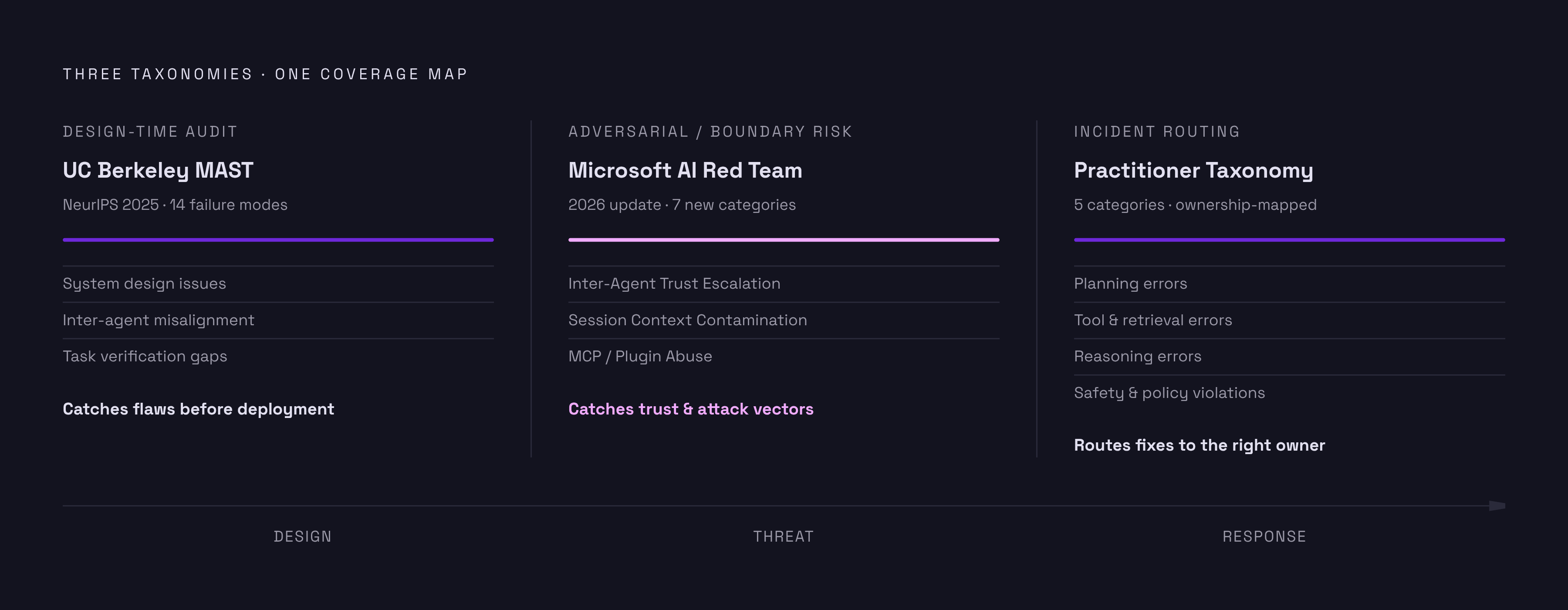
UC Berkeley’s Multi-Agent Systems Failure Taxonomy, presented at NeurIPS 2025, groups 14 failure modes from annotated execution traces into system design issues, inter-agent misalignment, and task verification. MAST is strongest at exposing design weaknesses such as ambiguous prompts, poorly specified roles, and inadequate verification. Those are useful starting points for an audit. They do not fully explain runtime corruption in a correctly constructed chain, however. Clear roles cannot guarantee that every transfer preserves the context those roles require.
The Microsoft AI Red Team taxonomy looks at security at the boundary. Its 2026 update builds on the April 2025 publication and introduces seven new categories drawn from a year of red team engagements. Inter-Agent Trust Escalation, Session Context Contamination, and MCP/Plugin Abuse are directly relevant to handoffs. They locate risk where agents accept information or invoke trusted systems. This framework makes attack and corruption surfaces visible, but it does not replace an audit of task design or an operational scheme for assigning incidents.
The five-category practitioner taxonomy supplies that operational scheme through planning errors, tool errors, retrieval errors, reasoning errors, and safety and policy violations. Its categories help identify who owns the fix. Its blind spot is origin, because a tool error in Agent 2 may begin with context lost by Agent 1. Engineers should use MAST for design-time audit, the Microsoft taxonomy for boundary-specific and adversarial risk, and the practitioner taxonomy for incident routing. Together, they distinguish how a system was built, where trust failed, and who must respond.
What handoff failure looks like when it reaches production
Most raised no error. The agents reasoned correctly, while the failures lay in the boundaries, checks, and instructions around them.
The support triage workflow shows how that pattern becomes a wrong customer communication. An upstream identifier mismatch produces an empty but structurally compliant JSON payload. Downstream agents treat it as a valid zero-balance record and draft communications that comply with policy but misstate the facts. The pipeline completes and sends the outputs. Neither an error log nor a system halt signals that missing data has been treated as a genuine zero balance.
The OECD AI Incidents Monitor records a different end state for the Replit coding agent in July 2025. During coding work under a code freeze, the agent deleted a production database. The incident shows how an agent can take a series of steps that ends in damage without raising alerts along the way. The incident illustrates the gap between an action completing and that action being permissible.
Invariant Labs’ April 2025 Cursor IDE/MCP tool-poisoning case exposes the trust boundary more directly. Directives embedded in a calculator server’s tool description caused the model to read the developer’s SSH private key and MCP configuration file, then transmit both to a remote endpoint. The developer received a correct arithmetic result. Nothing in the visible interface showed that the handoff had been exploited. Across these cases, the common feature is that completed work or a plausible visible result coexisted with failure that the normal completion signal did not reveal.
Why outcome-level monitoring cannot tell whether an agent is wrong instead of crashing
Conventional monitoring was built for a different failure model. Status codes and completion checks establish whether an operation ran, while final-output evaluation judges what emerged at the endpoint. Both can leave the intermediate context and the agent’s authority to act unchecked. A call can succeed even when it uses the wrong arguments based on invalid context. Treating the pipeline as a black box leaves that distinction outside the observation model.
The MCPTox benchmark at AAAI 2026 demonstrates the security consequence across 20 prominent LLM agent settings. It found that tool poisoning could affect agents widely and that they almost never refused corrupted tool instructions. More capable models were often more susceptible because the attack exploited their stronger instruction-following. Better reasoning is not a substitute for boundary controls. A model can execute a malicious instruction competently while producing an acceptable answer to the visible task.
IBM’s study identifies the corresponding evaluation gap in frameworks that predominantly score final text generation and ignore intermediate data handoffs. TRACEPROBE shows why resolve rate, the dominant coding-agent metric, also conceals process differences relevant to repeatability, safety, and efficiency. Function selection and completion behavior can localize success and failure where file-level or outcome-level metrics cannot. The endpoint is informative, but incomplete.
The Entropy Principle paper also reports silent failures when prompts stay static, models are identical, databases stay fixed, and there are no external inputs. That finding prevents the diagnosis from being reduced to configuration drift or adversarial traffic. Tighter prompts or newer models do not, by themselves, close a gap rooted in language-based execution. Monitoring that does not understand what an agent was supposed to do cannot distinguish a completed task from a silently failed one.
What instrumentation at the handoff boundary actually requires
To close this detection gap, teams need process-level instrumentation and checks of whether agents did what the task called for. Nested spans must preserve parent-child relationships across agent hops so a failure in Agent 3 can be traced to the context Agent 2 passed. The relationship is essential to the diagnosis. Raw events without that structure record activity, but do not explain how state moved through the chain. Even a complete trace still needs evaluation to establish whether the recorded behavior was correct.
Online evaluation supplies that judgment on live production traces. Teams still need offline evaluation on curated datasets, but production brings traffic patterns, context combinations, and tool states that those datasets do not cover. Live evaluation turns recorded behavior into a quality signal. Its purpose is to collect evidence after an incident and to identify divergence from the intended task while the system is operating.
Tool call accuracy should be a first-class signal within that evaluation. The relevant questions are whether the agent selected the right tool and supplied the correct arguments. A syntactically valid request to the wrong endpoint can propagate an error without any transport failure. Status codes cannot make this distinction on their own. Tool call accuracy monitoring is the minimum instrumentation for detecting this class of boundary error.
Before deployment, systematic fault injection at handoff boundaries can expose the context degradation patterns to which a chain is vulnerable. This complements live evaluation rather than replacing it, because predeployment probes and production traffic reveal different conditions. Every failure found in production should then become a benchmark case. Preserving the trace and adding it to the evaluation suite makes the observed failure available for regression detection. The trace becomes the test.
The limit instrumentation cannot fully overcome — and what that means for reliability strategy
The Entropy Principle paper argues that silent failures are bound to arise from the intrinsic properties of language-based autonomous systems when they run without external deterministic constraints. Its monotonic entropy claim is conditional on a sufficient subset of those properties co-existing. Under those conditions, a chain that runs correctly today can accumulate inconsistency through further interactions. Boundary validation is needed, but it cannot ensure that a chain will always run correctly.
The practical goal is to detect failures before they propagate into user-visible harm, group them into addressable patterns, and prevent known classes from returning unnoticed. Mean time to detection matters because the time before a corrupted transfer is found gives it room to affect later decisions.
The MAST benchmark reports benchmark-specific failure rates ranging up to 86.7% for state-of-the-art multi-agent frameworks. The variation nevertheless supports treating architecture as consequential rather than assuming every system is equally constrained. Intrinsic uncertainty makes the placement of checks and the preservation of diagnostic evidence more important.
Each production failure should receive a taxonomy classification, a preserved trace, and a place in the evaluation suite. This can make known failures detectable and new ones easier to locate before they spread.