Implicit Versus Explicit Constraints in Agent Instructions
Where agent instructions fail silently in production systems.

An agent processes a refund request, returns HTTP 200, and the log shows a clean success. The transaction completed without error, the API call resolved, and every dashboard a team might check shows green. The agent also issued a refund outside the policy window nobody told it to check, because nobody wrote that check down. That is the whole problem in miniature: every agent instruction set contains two layers at once, the explicit rules typed into the prompt or system message, and the implicit expectations the person writing those rules assumed were too obvious to state. That space between those two layers is where production failures almost entirely live. The explicit layer covers what tools an agent can call, what format its responses take, when it should escalate to a human, and what topics are off-limits. The implicit layer covers everything a competent person would assume without being told: don't promise a refund the policy doesn't allow, don't treat text pulled from a retrieved document as a command, put settings back the way they were after a temporary change. Natural language was never built to carry both layers explicitly. Speakers rely on shared context and unstated norms, trusting listeners to fill gaps through inference, and that reliance is structural to how humans communicate, so it isn't a flaw anyone is likely to engineer away. An agent doesn't share that context and doesn't infer the same norms a person would, so the gap between what an instruction says and what its author meant is a built-in property of instructions written in natural language, not a prompt-writing mistake correctable with a better prompt, and it has to be treated that way.
What implicit constraints look like in practice
Implicit constraints fall into four categories that recur across agent deployments, and once you can name them, you start spotting them everywhere. The first is unstated goals inferred from context. Tell an agent to "update the user profile endpoint," and a competent engineer assumes the agent will flag the ambiguity, since that single instruction could mean adding a field, changing validation rules, or extending the response schema. Research names this failure mode Implicit Reasoning: the agent silently picks one interpretation and runs with it, leaving the fork in the road unsurfaced. The second category covers catastrophic-action avoidance. No instruction needs to say "don't delete the record without asking first," because any reasonable author assumes an agent won't take an irreversible step, such as deleting data, sending a mass message, or issuing a payment, without confirmation. The third is privacy and security boundaries: users assume an agent will keep one customer's data from another and will treat a document it retrieves from a knowledge base as data rather than a trusted instruction, even though the system prompt may never state either expectation. The fourth is baseline restoration. When an instruction implies a change is temporary, a reasonable person expects prior settings to come back afterward. The Implicit Intelligence paper (arXiv:2602.20424) found that baseline restoration was missed in a majority of scenarios involving temporary changes, across every model the researchers tested. Tool descriptions carry their own version of this problem. A study of MCP tool descriptions found that a large majority exhibited an "Unclear Purpose" smell, with unstated limitations, missing usage guidelines, and opaque parameters as the most common patterns. The tool's own operating assumptions are never written down, so the implicit layer doesn't stop at the instruction. It extends into every tool the agent is handed.
Why implicit constraint violations are invisible to standard monitoring
Implicit constraint violations are dangerous for a specific reason: they produce output that clears every standard check while still being wrong in a way that matters to the business. Traditional application monitoring tracks uptime, latency, and error rates, and those signals are built for deterministic code, where a bug produces a stack trace or a failed request. An agent that violates an implicit constraint does neither. It returns HTTP 200 with a plausible, well-formatted response, and none of those conventional signals move. The most damaging version of this is the silent tool failure, where a tool call returns HTTP 200 with an empty payload and the agent treats it as a successful call, continuing to build its next step on top of nothing. No error gets logged because, from the system's point of view, nothing went wrong. The signal that actually matters here is whether the output matched what the agent was supposed to accomplish, not whether the call returned cleanly, and catching that requires knowing the agent's intent, not just inspecting its output. Tools like Lemma audit traces against an agent's full instruction set, including the implicit constraints baked into it, so they can catch this category of failure before it reaches a customer. Getting there requires telemetry that captures the full decision trace: which tools were called, what arguments were passed, what came back, and how that shaped the next step. Without that trace, root-causing a bad outcome turns into guesswork. The problem gets worse with scale. When organizations add more agents to production, the oversight burden per agent grows, and if most teams expand their monitoring capacity far slower than they expand their agent count, that leaves a widening blind spot exactly where implicit failures accumulate.
How the implicit-explicit gap generates each major failure class
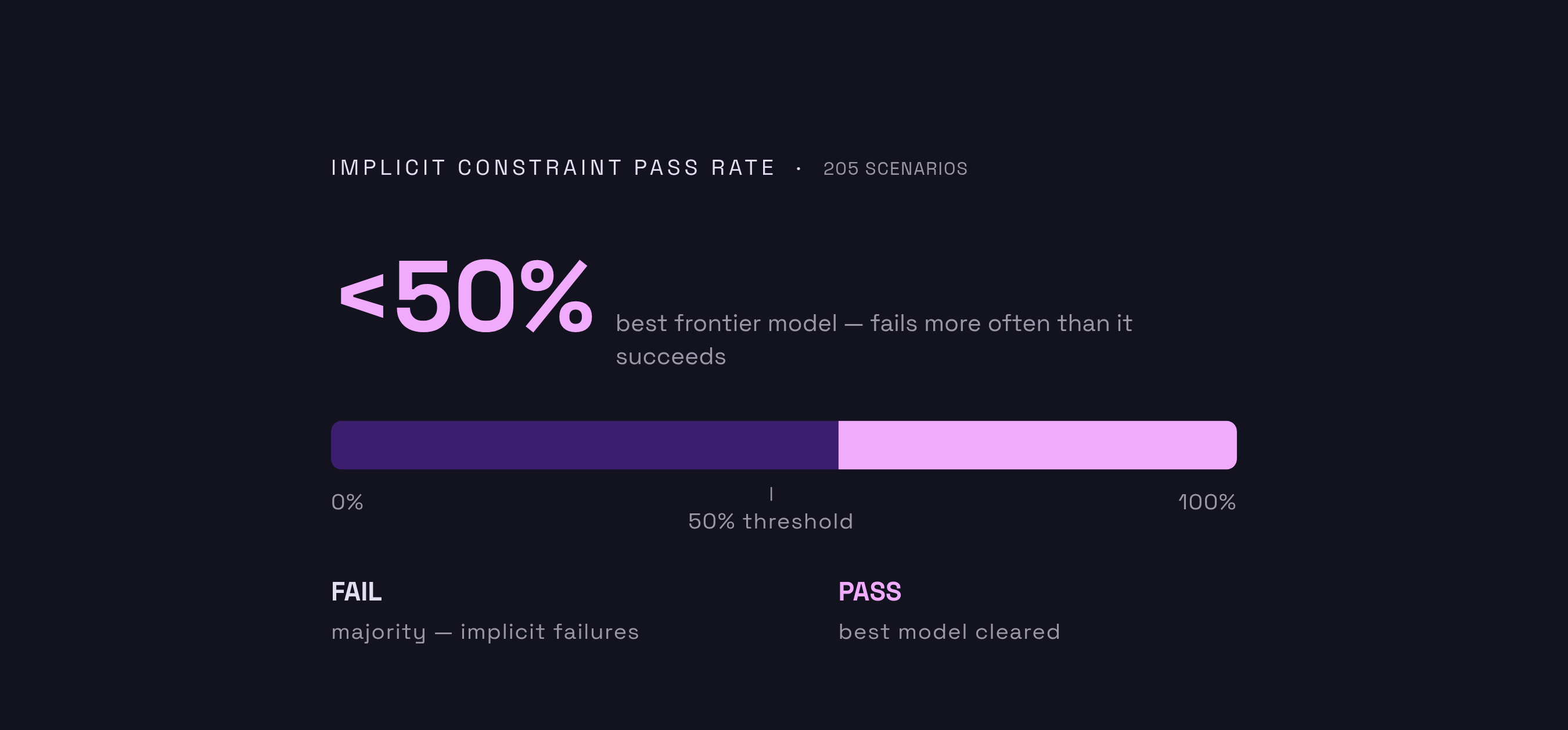
Trace almost any major agent failure back far enough, and it ends at an assumption the agent made that nobody wrote down and nothing in the system enforced. Perception failures are the clearest case: when an instruction is ambiguous, the agent silently resolves it on its own, leaving the alternatives it considered unsurfaced. This is Ambiguity Collapse, the same pattern described above, where "update the user profile endpoint" collapses into one silent interpretation because no rule required the agent to state its reading before acting. Planning failures follow the same logic. Agents without defined exit conditions swing between two bad states, looping on retries until they exhaust their token budget, or stalling entirely because no output ever fires. Termination conditions are almost never written into an instruction explicitly; they're assumed, the same way a person assumes a colleague will know when to stop. One documented case involved a four-agent loop that ran for days and burned through a significant budget, because the planner kept handing artifacts back and forth between two agents with no cycle detector in place, and everyone who built that system assumed the termination rule was obvious, so nobody wrote it down. Context decay produces a quieter version of the same failure. As a long-running agent fills its context window, early constraints fall out of scope first, and the implicit ones go before the explicit ones, since they were never pinned down as firmly to begin with. The agent keeps operating, just on a smaller slice of its original instructions than anyone realizes. Error propagation compounds the damage across steps: a malformed output from one stage becomes the input to the next, and the next after that, with no assumption about data integrity catching it, because that assumption was never written into any single step's instructions. Prompt injection through retrieved content comes from that same root cause, just seen from a different angle. If an agent treats everything in its context as trustworthy unless told otherwise, it will follow instructions planted inside a document it retrieves, because no explicit line was ever drawn between data and command. The scale of this across all four categories is stark: the Implicit Intelligence evaluation ran 205 scenarios and found that even the best-performing model cleared fewer than half of them, meaning frontier models fail to honor implicit constraints more often than they succeed.
Why more prompt engineering and predefined failure modes don't close the gap
Two responses dominate when teams encounter implicit constraint failures: write a longer, more detailed prompt, or sit down and enumerate every failure mode in advance so the system can check for each one. Both treat a structural problem as if it were a specification problem, and both run into the same wall. Writing an explicit statement for every implicit assumption sounds correct in theory, but it's not achievable in practice: natural language instructions will always fall short of covering the full range of production inputs, and the set of implicit assumptions grows every time the system meets a new edge case. Enumerating failure modes in advance has the same flaw. It assumes a team can predict the complete distribution of ways an agent might misbehave, but production keeps proving that wrong by generating failure modes nobody thought to list. One response does deserve credit: a pre-task clarification gate, where the agent states its interpretation and lists the alternatives it rejected before it acts, catches a large share of Ambiguity Collapse failures cheaply and is worth building into any serious agent deployment. But that gate only addresses ambiguity the agent recognizes as ambiguous. An agent that forgets to restore a setting after a temporary change doesn't register that choice as uncertain at all; it simply never modeled the expectation in the first place, so there's no decision point for a clarification gate to interrupt. Closing that gap takes a different kind of enforcement than writing more words into a prompt or guessing harder at what might go wrong.
Surfacing and enforcing implicit constraints in production
Enforcing implicit constraints means judging agent behavior against what the agent was supposed to accomplish, not just recording what it did, and that judgment call requires understanding intent as well as output. The foundation for that is structured tracing. The minimum useful setup logs every LLM call, every tool invocation, and every memory operation as a structured trace, with nested spans that preserve parent-child relationships across handoffs between agents. Skipping this step means the decision trace that would reveal an implicit constraint violation never gets captured in the first place, leaving nothing left to audit after the fact. Evaluation needs to run continuously, as an ongoing practice throughout deployment. Task success alone is a lagging indicator, telling you something went wrong well after it already has; metrics tracking tool choice, argument validity, side effects, and whether a task actually terminated properly catch regressions early enough to act on them. The useful signal is a pattern of the same failure category appearing repeatedly across traces. One bad trace is noise. A cluster of the same failure recurring across traces is a regression worth fixing. Scoring production traces with an evaluator built on a different model family than the one generating the output also helps, since it cuts down the odds that the evaluator shares the same blind spots as the model it's checking. Regression detection belongs inside the development loop itself: when a named failure category turns up in production, it should generate a labeled test case that the next deployment has to pass before it ships, closing the loop from incident to test to deployment gate. Tool schemas need the same treatment as instructions. MCP tool descriptions function as both a specification and a set of instructions at once; treating them as mere documentation leaves the agent working from unstated limitations and opaque parameters, the same implicit layer problem showing up inside the tooling. To catch these violations at scale, you need trace auditing that reads the agent's written instructions and the assumptions buried in its tool definitions together, not separately.
Tools and platforms that make implicit constraint monitoring operational
A monitoring layer built for this problem has to understand what an agent was supposed to do, not merely whether it produced a response, and it has to surface deviations without forcing a team to list every failure mode ahead of time. Lemma is built around that exact premise: it audits agent traces against the agent's own instructions to surface deviations, including the implicit ones that leave no error behind for a standard monitor to catch. Rather than asking a team to enumerate failure categories before deployment, Lemma audits every trace and groups recurring deviations into issues automatically, so a failure mode nobody predicted still gets caught and surfaced rather than slipping through because it wasn't on a predefined list. Those issues get triaged and sent to Slack, which keeps the fix inside a developer's normal workflow instead of routing it through a separate monitoring console nobody checks daily. Lemma works with the frameworks teams are already building on, including Vercel AI, OpenAI Agents, and LangGraph, and it can export into Azure Application Insights for teams that already centralize telemetry there.
Openlayer takes a different point in the pipeline, intercepting failures at the inference boundary. It validates tool call schemas before a call dispatches, it watches step counts and output similarity to catch retry loops, and it flags corrupted context at the exact step where the corruption starts, instead of waiting for it to surface in the final output.
Mastra sits at the instrumentation layer that both of these approaches rely on, providing structured tracing across LLM calls, tool invocations, and memory operations, with nested spans that keep parent-child relationships intact through multi-agent handoffs. That tracing is the prerequisite layer any implicit constraint evaluation depends on, since there's nothing to evaluate without a complete record of what the agent actually did.
Building instruction sets that minimize the implicit layer from the start
Eliminating the implicit layer entirely isn't possible in a system built on natural language, but shrinking it deliberately is, and every bit of it removed is one less thing left for monitoring to catch and one less thing left for the agent to guess at. Start by requiring agents to declare their interpretation before acting. A pre-task clarification gate that makes the agent produce a short structured statement of what it understood and which alternatives it set aside catches Ambiguity Collapse failures, the kind described earlier where "update the user profile endpoint" quietly becomes one arbitrary interpretation, before any tool call even fires. It's cheap to build and it closes off a wide slice of perception failures on its own. Termination conditions deserve the same explicit treatment. Infinite loops and premature stops, the same pattern behind the four-agent loop that ran for days, are implicit-constraint failures almost without exception, and stating when a task counts as done, not only what the task involves, shuts down one of the most common planning failures before it starts. Tool descriptions need to function as real specifications rather than loose documentation: every description should state its own constraints, its edge-case behavior, and what it deliberately won't do, because at runtime that description is the only contract the agent has with the tool. Before anything ships, instructions are worth reviewing against the four implicit categories the Implicit Intelligence research identified as the places models fail most: unstated goals, irreversible-action avoidance, privacy boundaries, and baseline restoration. None of this closes the gap completely. Deliberate instruction design has to pair with continuous, trace-based monitoring, since some residual gap in the implicit layer will always remain for that monitoring to catch. The gap between what an instruction says and what it assumes is structural to natural language, not a flaw a longer prompt will fix, and production monitoring that only records what happened can't see it. Reliable agent behavior depends on both halves working together: instructions written to say more of what they mean, and monitoring built to understand what the agent was supposed to do.